Destructive Interference: How Waves Cancel Each Other Out
When two waves meet and the result is a quieter, even almost silent, spot, we’re witnessing destructive interference. It’s a fundamental concept in physics that explains why noise-canceling headphones work, why we can feel the vibration of a guitar string, and even how certain architectural designs reduce unwanted sound. Understanding this phenomenon is surprisingly straightforward once you break it down into its core components.
What Is Destructive Interference?
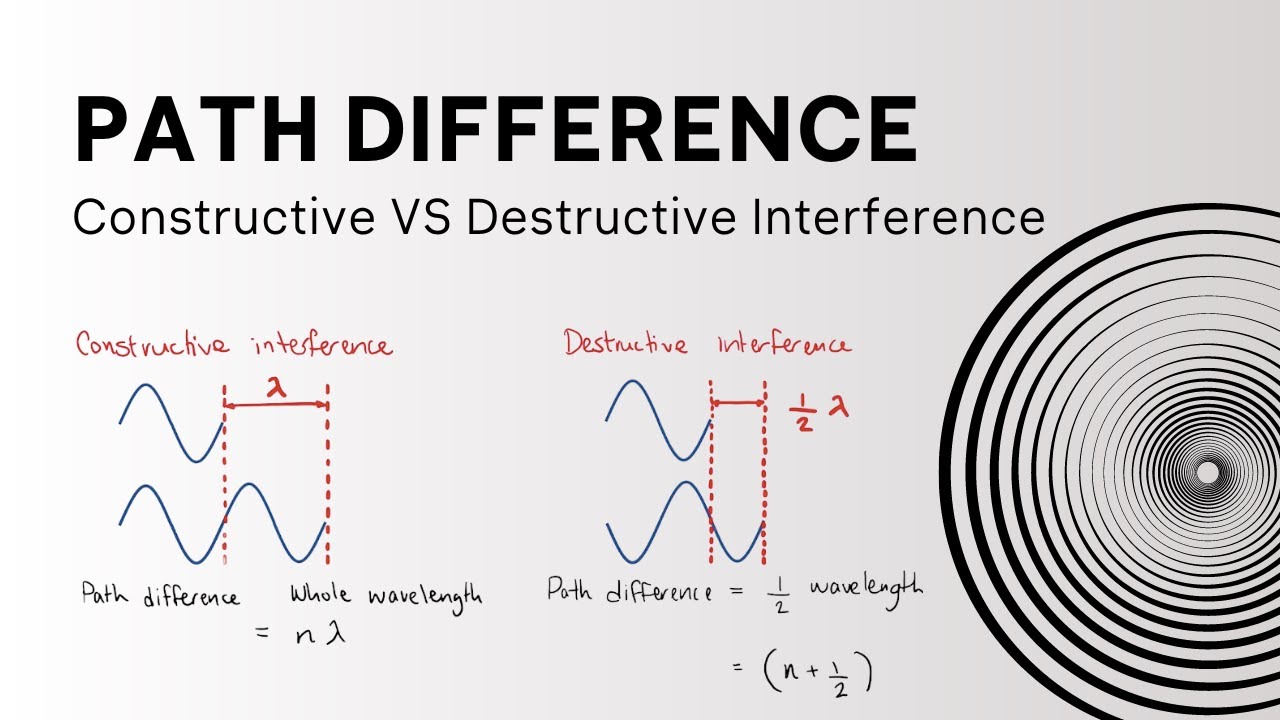
In the simplest terms, destructive interference happens when two waves overlap in such a way that their peaks line up with the troughs of the other wave. The opposing amplitudes partially or completely cancel each other out. If the two waves have exactly the same amplitude and are perfectly out of phase—meaning one’s crest aligns with the other’s trough—the resulting wave has zero amplitude at that point, producing complete silence or no visible disturbance.
The Science Behind the Cancellation
Waves are disturbances that transfer energy through space or a medium. They can be sound, light, water ripples, or even electromagnetic waves. The key property that allows them to interfere is their phase, a measure of how far a wave has progressed through its cycle. When two waves with the same frequency and amplitude arrive at a point but are 180° out of phase, their displacement values at that point sum to zero. Mathematically, if one wave is described by \(y_1 = A\sin(\omega t)\) and the other by \(y_2 = A\sin(\omega t + \pi)\), the combined wave is \(y = y_1 + y_2 = 0\). That simple addition illustrates the elegance of destructive interference.
Everyday Examples of Destructive Interference
- Noise-canceling headphones: Microphones pick up ambient noise, then generate an opposite wave that cancels it out within the earcup.
- Acoustic engineering: Speakers arranged at specific angles can reduce reverberation in concert halls by cancelling certain sound reflections.
- Water ripples: When two waves on a pond intersect at a point where one’s crest meets the other’s trough, the surface momentarily flattens.
- Laser interference patterns: In optics labs, two coherent beams can produce dark fringes where destructive interference occurs.
How to Observe Destructive Interference in the Lab
- Set up a water tank: Fill a shallow tray with clear water and place two identical slits in a barrier at a fixed distance apart.
- Create waves: Use a small vibrating paddle or a submerged speaker to generate waves from both slits simultaneously.
- Watch the pattern: Adjust the distance between the slits until you see alternating bright and dark bands—those are constructive and destructive zones.
- Measure intensity: Place a small object, like a piece of paper, at the dark zones; it will hardly move, indicating minimal wave energy.
Repeating the experiment with sound waves—using two speakers set 180° out of phase—produces a similar cancellation, although the effect is more subtle due to air’s lower reflectivity compared to water.
Common Misconceptions About Destructive Interference
Many people assume that destructive interference always results in total silence. In reality, the cancellation is most complete when the two waves are identical in amplitude and perfectly out of phase. If one wave is stronger or their phases are only slightly offset, the cancellation will be partial, leaving a faint echo or reduced noise level. Another confusion is that destructive interference only occurs in linear systems; however, many real-world materials exhibit near-linear behavior for moderate wave amplitudes, making the principle still applicable.
Why Understanding Destructive Interference Matters
Beyond the novelty of waves canceling each other, this knowledge has practical applications. Engineers use it to design sonic fences that deter animals without harming them, create anti-reflective coatings for glass by canceling reflected light, and improve ultrasound imaging by reducing scattered signals. Even musicians exploit destructive interference to sculpt the tone of an instrument by strategically placing pickups or adjusting string tension.
FAQ
- Can destructive interference happen with any type of wave? Yes, as long as the waves are coherent and share the same frequency, the principle applies.
- Why do headphones with no noise cancellation still reduce background noise? They rely on passive isolation—physical barriers—rather than active destructive interference.
- Is destructive interference the same as destructive interference in physics? In everyday use, “destructive interference” specifically refers to the cancellation of waves, not to destructive phenomena in other contexts.