Permutation, Combination & Probability: Sample Problems
When you hear “permutations, combinations and probability example problems,” the first thought is often “math anxiety.” Yet these topics are the backbone of everyday decision‑making, from arranging seating at a wedding to estimating the odds of drawing a specific hand in cards. Below, we break down the core ideas, walk through a handful of problems, and show how a systematic approach turns confusion into confidence.
Understanding the Basics of Permutations and Combinations
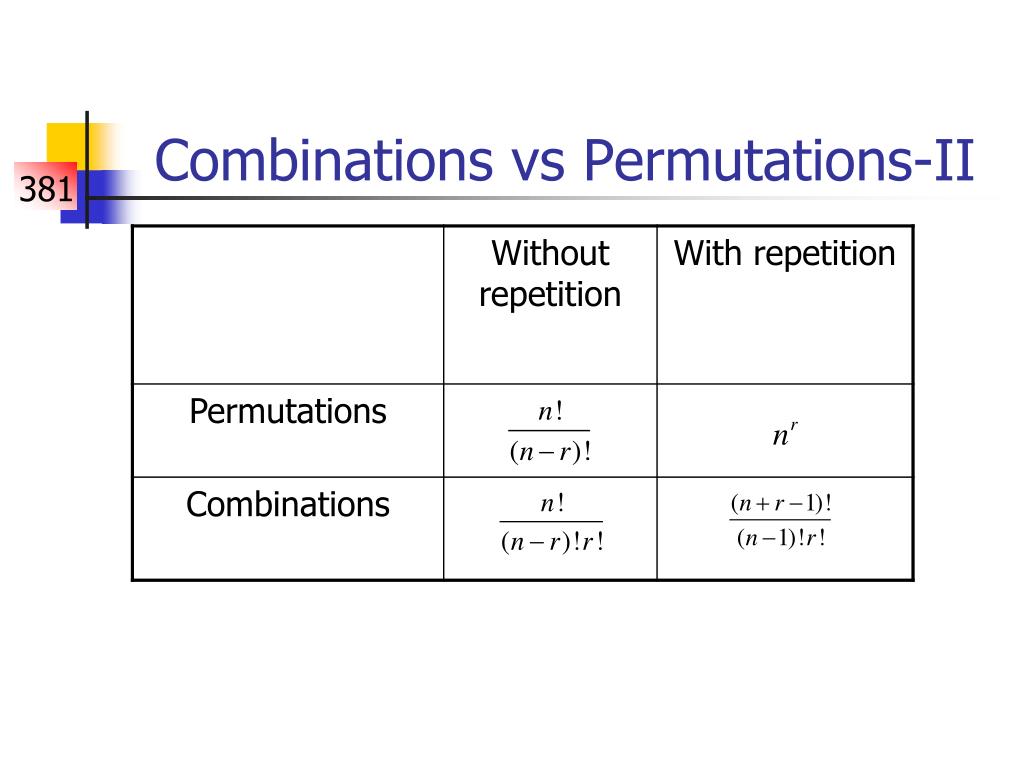
At its heart, a permutation cares about order. If you line up three friends—Anna, Ben, and Cara—there are 6 different ways they can sit: ABC, ACB, BAC, BCA, CAB, CBA. The formula n ! / (n‑r) ! captures this, where n is the total items and r the spots to fill.
A combination, by contrast, ignores order. Using the same trio, the question “how many ways can we choose two friends?” yields only 3 pairs: AB, AC, BC. The formula n ! / [r! · (n‑r)!] does the heavy lifting.
Example 1: Arranging Books on a Shelf
- Five distinct novels are to be displayed. How many possible orders?
Here order matters, so we use a permutation: 5 ! = 120. If the problem changed to “pick any three novels to read this month” (order irrelevant), the answer would be 5 ! / (3!·2!) = 10.
Example 2: Forming a Committee
- A club has 8 members. A president, vice‑president, and secretary are to be elected. How many ways?
This is a permutation because each role is distinct: 8 · 7 · 6 = 336, which matches 8 ! / (8‑3)!.
Notice how swapping “president” with “secretary” creates a different outcome—hence the reliance on permutations.
Example 3: Lottery Numbers
- A lottery draws 6 numbers from 1‑49, order does not matter. How many possible tickets?
Now we’re in combination territory: 49 ! / (6!·43!) ≈ 13,983,816 tickets. This huge figure explains why the jackpot feels so tantalizingly out of reach.
Probability Problems that Tie It All Together
Probability asks, “What’s the chance that a particular outcome occurs?” It’s essentially a ratio: favorable outcomes over total possible outcomes. When permutations or combinations define those outcomes, the two concepts merge.
Example 4: Drawing Cards
- From a standard 52‑card deck, what’s the probability of drawing a hand of 5 cards that contains exactly 2 aces?
First, count the favorable hands. Choose 2 of the 4 aces: C(4,2)=6. Then choose the remaining 3 cards from the 48 non‑aces: C(48,3)=17,296. Multiply to get 103,776 favorable hands.
The total number of 5‑card hands is C(52,5)=2,598,960. So the probability is 103,776 / 2,598,960 ≈ 0.04, or about 4 %.
Example 5: Seating Arrangements with Restrictions
- Four siblings sit in a row of six seats. Two specific seats must remain empty. How many ways can they be arranged?
First pick which two seats stay empty: C(6,2)=15. The remaining four seats are filled by the siblings, where order matters, so 4! = 24. Multiply: 15 · 24 = 360 possible arrangements.
If we ask for the probability that a random seating of the six seats satisfies the “two empties” condition, we’d divide 360 by the total number of ways to place four people in six seats (P(6,4)=6·5·4·3=360). Interestingly, the probability is 1—meaning every arrangement automatically leaves two seats empty, a neat illustration of how constraints shape the sample space.
Example 6: Mixed‑Bag Sampling
- A bag contains 3 red, 4 blue, and 5 green marbles. If three marbles are drawn without replacement, what’s the probability all are different colors?
Count favorable sequences: pick a red (3 ways), then a blue (4 ways), then a green (5 ways). Since order matters in drawing, multiply: 3·4·5 = 60. The total number of ordered draws is P(12,3)=12·11·10 = 1,320. Thus probability = 60 / 1,320 ≈ 0.0455, about 4.6 %.
Alternatively, using combinations eliminates order: C(3,1)·C(4,1)·C(5,1)=60 favorable sets, over C(12,3)=220 total sets, giving 60 / 220 ≈ 27 %. The discrepancy highlights why clarifying “ordered” vs. “unordered” draws is crucial.
Tips for Tackling Similar Problems
- Define the sample space first. Whether you’re counting permutations or combinations, a clear picture of all possible outcomes prevents overcounting.
- Watch for “order matters.” If the problem mentions positions, roles, or sequences, lean toward permutations.
- Identify restrictions early. Conditions like “no two women sit together” often require splitting the problem into stages.
- Convert between ordered and unordered counts. Multiplying a combination count by the factorial of the chosen items restores the permutation perspective when needed.
Frequently Asked Questions
When should I use permutations instead of combinations?
Use permutations whenever the arrangement’s order changes the outcome—think seating charts, race finishes, or passwords. If swapping two selected items yields the same result, you’re dealing with combinations.
Is the probability of an event always a fraction between 0 and 1?
Yes. Probability is defined as the number of favorable outcomes divided by the total number of equally likely outcomes, so the result can never exceed 1 or drop below 0.
Can I mix permutations and combinations in a single problem?
Absolutely. Many real‑world questions first choose a subset (combination) and then arrange that subset (permutation). The key is to separate the steps and apply the appropriate formula at each stage.
How do “with replacement” and “without replacement” affect the calculations?
“With replacement” means each draw resets the pool, so probabilities stay constant and you often use simple multiplication. “Without replacement” reduces the pool after each draw, requiring permutations or combinations that account for the shrinking set.